Upper Ahobilam
( Eguva Ahobilam )
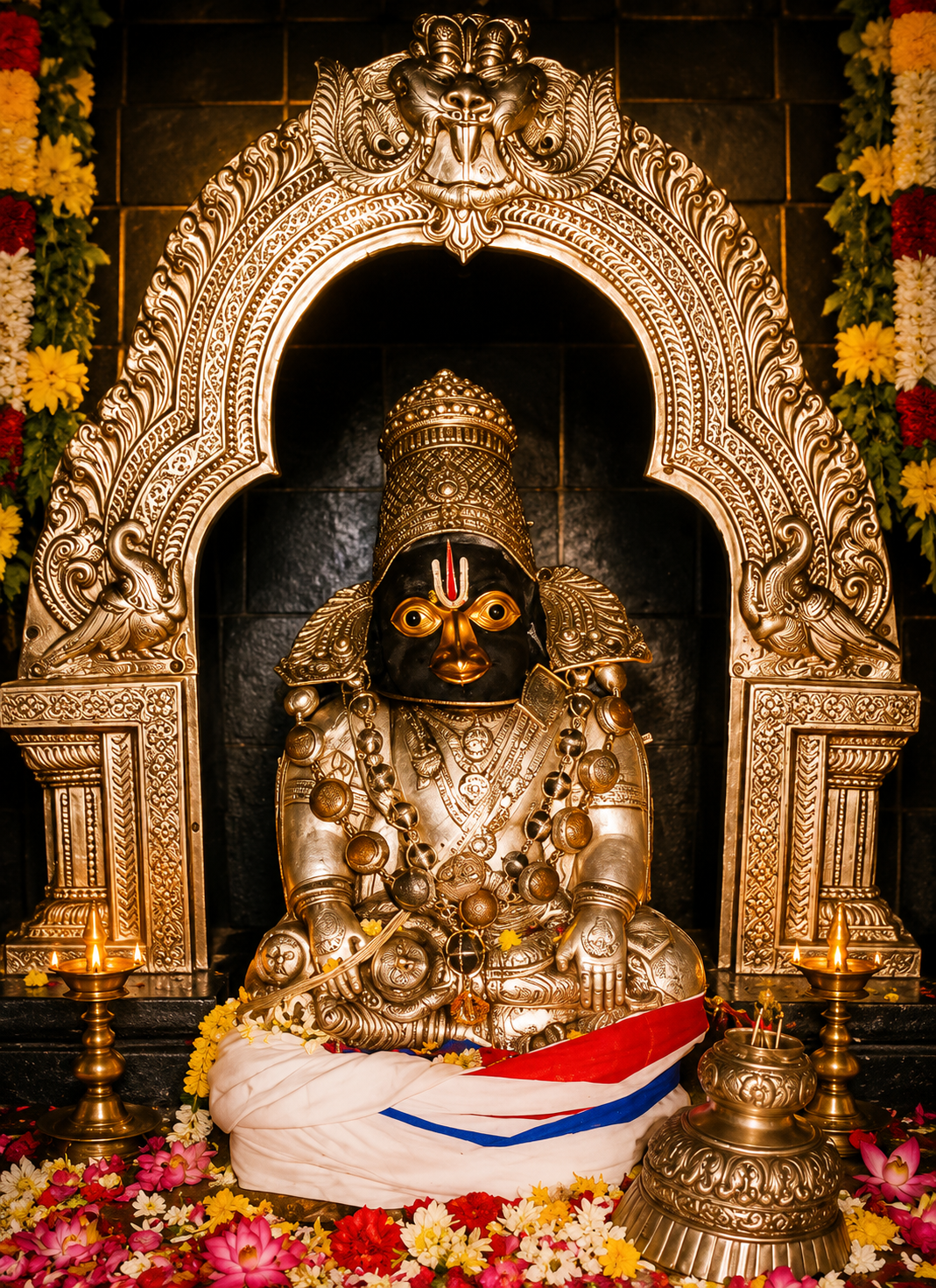
The Sacred Abode of Manifestation
Upper Ahobilam (Eguva Ahobilam) is the most sacred and spiritually significant part of Ahobilam, located deep within the dense Nallamala Hills of Andhra Pradesh. It is revered as the divine place where Lord Vishnu manifested as Lord Narasimha to protect His greatest devotee, Prahlada, and destroy the demon king Hiranyakashipu. Unlike many temples built on open plains, the main shrine of Upper Ahobilam is situated inside a natural mountain cave, giving devotees a profound feeling of entering the very place where the divine incarnation occurred.
According to the Brahmanda Purana, Vishnu Purana, Bhagavata Purana, and the sacred Ahobila Sthala Purana, Hiranyakashipu, the mighty king of the Asuras, performed severe penance and obtained extraordinary boons from Lord Brahma. Believing himself to be invincible, he declared that no one should worship Lord Vishnu. However, his own son, Prahlada, remained an unwavering devotee of Lord Vishnu. Despite being subjected to poison, fire, wild elephants, venomous snakes, and numerous cruel punishments, Prahlada never abandoned his devotion.
The Splitting of the Pillar
One day, Hiranyakashipu angrily asked Prahlada whether Lord Vishnu was present inside a stone pillar. Prahlada replied with complete faith that the Lord is present everywhere. Enraged by this answer, Hiranyakashipu struck the pillar with his mace. At that very moment, the pillar split open with a thunderous sound, and Lord Vishnu appeared in the magnificent form of Lord Narasimha, a divine incarnation who was neither man nor beast but half-man and half-lion.
At twilight, on the threshold of the palace, Lord Narasimha placed Hiranyakashipu upon His lap and tore him apart with His divine claws, fulfilling every condition of Brahma's boon without violating any of them. This extraordinary event symbolizes the eternal triumph of righteousness over evil and the Lord's unwavering promise to protect His devotees.
The Meaning of Ahobilam
Aho Balam
One explanation derives from the Sanskrit words "Aho" meaning "wonderful" and "Balam" meaning "strength." Witnessing the unimaginable power of Lord Narasimha, the Devas exclaimed, "Aho Balam!" meaning "Oh! What immense strength!"
Aho Bila
Another traditional explanation derives the name from "Aho Bila", meaning "Wonderful Cave," referring to the sacred cave in which the self-manifested deity resides. Both interpretations continue to be revered in the temple tradition.
After slaying Hiranyakashipu, Lord Narasimha remained in His fierce Ugra (terrifying) form. Even the Devas, sages, and celestial beings could not calm Him. Finally, Prahlada approached the Lord with complete humility and devotion. Pleased with Prahlada's unwavering faith, Lord Narasimha gradually became peaceful and blessed him. This sacred land where the Lord manifested in His powerful form is worshipped today as Upper Ahobilam.
The presiding deity of Upper Ahobilam is Sri Ahobila Narasimha Swamy, worshipped in His fierce Ugra Narasimha form. The deity is believed to be Swayambhu (self-manifested) and resides inside a naturally formed cave surrounded by rugged mountains and dense forests. The cave itself is regarded as one of the holiest places in the Sri Vaishnava tradition.
Royal Patronage & The Ahobila Mutt
Historically, Upper Ahobilam has been a major centre of Narasimha worship for more than a thousand years. It is one of the 108 Divya Desams, the sacred Vishnu temples praised by the Alwars. The temple received royal patronage from the Western Chalukyas, Kakatiya Kings, Reddy Kings, and especially the Vijayanagara Empire. Emperor Sri Krishnadevaraya visited the temple and offered valuable ornaments, land grants, and financial support for daily worship and temple maintenance. Many of the stone mandapas, pathways, inscriptions, and architectural additions visible today belong to the Vijayanagara period.
Upper Ahobilam is also the birthplace of the renowned Sri Ahobila Mutt, founded by Sri Adivan Sathakopa Yatheendra Mahadesikan under the divine command of Lord Narasimha. Since its establishment, the Ahobila Mutt has preserved the temple's traditions, Vedic rituals, festivals, and Sri Vaishnava philosophy for centuries. Even today, the Jeeyars of the Ahobila Mutt continue to administer and protect the sacred traditions of the temple.
A Spiritual Gateway
Upper Ahobilam serves as the spiritual gateway to several other Nava Narasimha temples, including Malola Narasimha, Kroda (Varaha) Narasimha, and Jwala Narasimha. The sacred trek to Ugra Sthambham, believed in temple tradition to be associated with the divine manifestation of Lord Narasimha, also begins from Upper Ahobilam. Pilgrims pass through mountain streams, waterfalls, rocky paths, caves, and dense forests, making the journey both spiritually uplifting and physically memorable.
Every year, thousands of devotees from across India visit Upper Ahobilam to participate in Narasimha Jayanti, Brahmotsavam, Vaikuntha Ekadashi, Dolotsavam, and other annual festivals. The temple resonates with Vedic chanting, Abhishekam, Alankaram, and traditional Sri Vaishnava rituals, preserving a continuous heritage of devotion spanning many centuries.
"Today, Upper Ahobilam remains one of the holiest Narasimha temples in the world. Surrounded by the majestic Nallamala forests, ancient caves, sacred streams, and timeless traditions, it continues to inspire millions of devotees with its divine history, spiritual power, and the eternal message that sincere devotion, righteousness, and faith will always receive the protection and blessings of Lord Lakshmi Narasimha."