The Pinnacle of Ahobilam
The Jwala Narasimha Swamy Temple is one of the most sacred, awe-inspiring, and spiritually powerful shrines among the Nava Narasimha Temples of Ahobilam. Located high in the rugged Nallamala Hills of Andhra Pradesh, this temple is regarded as the highest and most difficult shrine to reach in the Nava Narasimha pilgrimage. Surrounded by dense forests, steep rocky cliffs, mountain streams, waterfalls, and breathtaking natural beauty, the temple stands as the ultimate symbol of Lord Narasimha's divine power and His victory over evil. Devotees believe that this is the very place where Lord Narasimha slew the demon king Hiranyakashipu, making it one of the holiest Narasimha temples in India.
The name "Jwala" is derived from the Sanskrit word meaning "Flame" or "Divine Fire." It represents the blazing anger of Lord Narasimha when He appeared to destroy Hiranyakashipu and protect His great devotee Prahlada. Among all the Nava Narasimha temples, Jwala Narasimha represents the Lord in His most fierce, fiery, and powerful manifestation. The divine energy of this form symbolizes the destruction of evil, protection of righteousness, and the triumph of truth over arrogance.
The Legend of Prahlada
According to the Bhagavata Purana, Vishnu Purana, Brahmanda Purana, and the sacred Ahobila Sthala Purana, the demon king Hiranyakashipu performed severe penance and received extraordinary boons from Lord Brahma. Filled with pride, he declared himself supreme and prohibited the worship of Lord Vishnu throughout his kingdom. However, his own son Prahlada remained an unwavering devotee of Lord Vishnu. Despite poison, fire, wild elephants, venomous snakes, and numerous cruel punishments, Prahlada never abandoned his faith.
One day, Hiranyakashipu angrily demanded to know where Lord Vishnu existed. Prahlada confidently replied that the Lord is present everywhere—even inside a stone pillar. Enraged, Hiranyakashipu struck the pillar with his mace. Instantly, the pillar split open with a thunderous roar, and Lord Vishnu manifested as Narasimha, the extraordinary half-man, half-lion incarnation.
The Divine Incarnation
At twilight, on the threshold of the palace, Lord Narasimha lifted Hiranyakashipu onto His lap and tore open the demon's chest with His divine claws, perfectly fulfilling every condition of Brahma's boon. Temple tradition reveres Jwala Narasimha Temple as the sacred place where this divine act took place. The fierce expression of the deity reminds devotees of the Lord's uncompromising commitment to protect Dharma and His devotees.
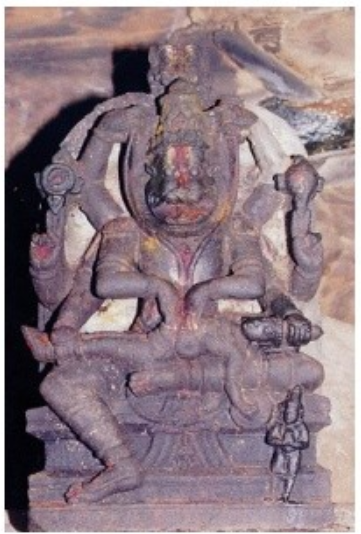
The presiding deity, Sri Jwala Lakshmi Narasimha Swamy, is worshipped in an intense Ugra (fierce) form. The deity is traditionally described with eight divine arms, holding the Shankha (Conch) and Sudarshana Chakra while simultaneously overpowering Hiranyakashipu. The Lord is shown tearing open the demon's chest and wearing his intestines as a garland, symbolizing the complete destruction of evil and the restoration of righteousness. This is considered the most powerful and fearsome form among the Nava Narasimha manifestations.
Within the temple complex are several sacred images associated with the Narasimha incarnation, including Sthambhodbhava Narasimha (Lord emerging from the pillar), the battle between Narasimha and Hiranyakashipu, Lord Maha Vishnu, and other important divine figures connected with the incarnation. These sacred representations help devotees understand the complete story of Lord Narasimha's appearance and divine mission.
Sacred Landmarks: Rakta Kundam & Ugra Sthambham
One of the most sacred places near the temple is Rakta Kundam (Rakta Gundam). According to temple tradition, after slaying Hiranyakashipu, Lord Narasimha washed His blood-stained hands in this natural rock pool. Even today, devotees observe that the water often appears reddish in color, and this sacred pond is regarded as one of the holiest theerthams of Ahobilam. Pilgrims reverently offer prayers at Rakta Kundam before continuing their journey.
A short distance beyond Jwala Narasimha Temple lies the famous Ugra Sthambham, one of the most sacred landmarks of Ahobilam. Temple tradition identifies this towering split rock as the symbolic pillar from which Lord Narasimha manifested to protect Prahlada. Thousands of devotees undertake the challenging trek to Ugra Sthambham every year, considering it the highest point of the Nava Narasimha pilgrimage.
The Penance of Garuda
Another ancient legend connected with this temple concerns Garuda, the divine vehicle of Lord Vishnu. Following the advice of Kashyapa Prajapati, Garuda performed severe penance on these sacred hills to realize the Supreme Truth. Pleased with his devotion, Lord Narasimha appeared before him in His blazing Jwala form and granted two divine boons. The Lord declared that the hill would forever be known as Garudadri, and Garuda would eternally remain His principal Vahana (divine vehicle). This legend further enhances the sanctity of Jwala Narasimha Temple.
Historical Significance & Ahobila Matha
Historically, the Jwala Narasimha Temple has existed for many centuries and forms one of the most important shrines of Ahobilam. Like the other Nava Narasimha temples, it flourished under the patronage of the Western Chalukyas, Kakatiya Kings, Reddy Kings, and especially the Vijayanagara Empire. During the reign of Emperor Sri Krishnadevaraya, generous donations, temple renovations, ornaments, and pilgrim pathways were established, strengthening Ahobilam's position as one of India's greatest Narasimha Kshetras.
For more than six centuries, the temple has remained under the spiritual care of the Ahobila Matha, founded by Sri Adivan Sathakopa Yatheendra Mahadesikan. The Matha continues to preserve the ancient Pancharatra Agama traditions, daily worship, Vedic chanting, annual festivals, and Sri Vaishnava philosophy associated with all the Nava Narasimha temples.
A Spiritual Journey
Architecturally, the temple is modest but extraordinarily powerful in its spiritual atmosphere. Built with traditional South Indian stone architecture, it blends naturally into the rugged mountain landscape. The steep trek through forests, rocky slopes, waterfalls, and streams is itself regarded as an act of devotion. Many pilgrims describe the journey to Jwala Narasimha as one of the most spiritually rewarding experiences in Ahobilam.
Every year, thousands of devotees visit the temple during Narasimha Jayanti, Brahmotsavam, Vaikuntha Ekadashi, Karthika Masam, and other important Sri Vaishnava festivals. Special Abhishekam, Archana, Alankaram, Vedic chanting, homams, and devotional processions are conducted with great reverence. Lighting a ghee lamp at Jwala Narasimha during the holy month of Karthika is considered especially auspicious and is believed to bring divine protection and prosperity.
The Eternal Triumph of Dharma
Spiritually, Sri Jwala Lakshmi Narasimha Swamy represents divine justice, fearlessness, protection, strength, and the complete destruction of evil. The temple teaches that no matter how powerful Adharma may appear, it can never overcome truth, devotion, and righteousness. Lord Narasimha's appearance at Jwala reminds every devotee that sincere faith will always receive divine protection.
Today, the Jwala Narasimha Swamy Temple stands as one of the most revered destinations of the Nava Narasimha pilgrimage. Surrounded by the majestic Nallamala forests, sacred Rakta Kundam, the legendary Ugra Sthambham, and centuries of mythology, history, and Sri Vaishnava tradition, the temple remains an eternal symbol of Lord Narasimha's limitless power, unwavering protection of His devotees, and the everlasting victory of Dharma over Adharma.